

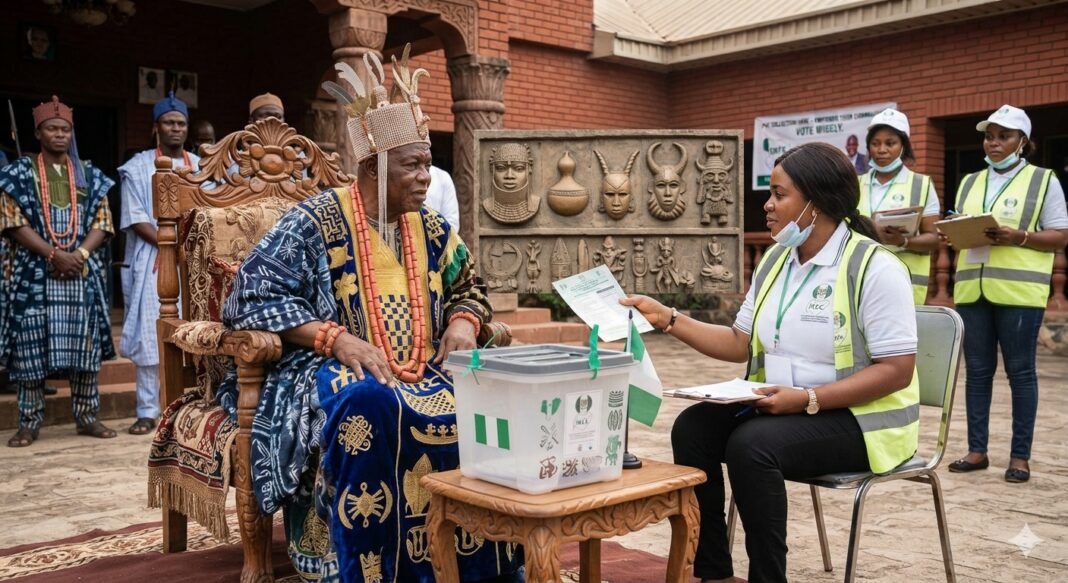
Traditional Rulers and Election Security in Nigeria: The Missing Link in Safeguarding Peace Ahead of the Forthcoming Elections – By Demebide Master Tony.
“To many observers, the Warri incident may appear insignificant because it did not result in large-scale violence. However, from an election security perspective, such actions represent critical early warning indicators. Electoral conflict rarely begins with violence. It usually starts with symbolic acts of rejection, political intolerance, aggressive rhetoric, identity-based mobilization, and growing hostility between opposing support groups”- Demebide.

As Nigeria inches closer to another election cycle, conversations around election security have understandably focused on the role of the Independent National Electoral Commission (INEC), the Nigeria Police Force, the Nigeria Security and Civil Defence Corps (NSCDC), and other security and governance institutions. While these organizations remain critical to the conduct of peaceful elections, a strategic stakeholder has continued to receive less attention than it deserves: the traditional institution.
In many parts of Nigeria, traditional rulers remain the most trusted custodians of community values, social order, and conflict resolution mechanisms. Unlike political actors whose influence is often cyclical, traditional rulers maintain a permanent presence within their communities. They understand local grievances, social fault lines, historical conflicts, and communal relationships better than most state institutions. It is this unique positioning that makes them indispensable to election security and democratic stability.
Nigeria’s electoral history provides sufficient evidence of the consequences of ignoring grassroots conflict dynamics. The post-election violence that followed the 2011 presidential election remains one of the darkest episodes in Nigeria’s democratic journey, resulting in widespread fatalities, destruction of property, and mass displacement. The events demonstrated that security interventions alone are insufficient if local tensions are not identified and addressed before they escalate.
The lessons learned from 2011 subsequently influenced election security planning in later years. During the highly contested 2015 General Elections, traditional rulers joined religious leaders, civil society organizations, and peacebuilding institutions in promoting political tolerance and non-violence. Their interventions complemented the efforts of the National Peace Committee and reinforced the principles of the Abuja Peace Accord, contributing to a relatively peaceful electoral process that culminated in Nigeria’s first democratic transfer of power from an incumbent government to the opposition.
The role of traditional rulers was equally evident during preparations for the 2023 elections. Alhaji Muhammadu Ibn Abali Muhammadu Idrissa, Chairman of the Yobe State Council of Traditional Rulers and Emir of Fika, embarked on community sensitization campaigns, warning citizens against political violence, thuggery, election malpractice, and hate-driven campaigns. His intervention highlighted the growing importance of traditional institutions in strengthening preventive election security measures at the grassroots level.
Similarly, traditional rulers across the South-East encouraged peaceful participation in the electoral process and appealed to citizens to resist actions capable of undermining democratic engagement. These interventions contributed significantly to voter confidence and community stability.
In Edo State, Oba Ewuare II of Benin publicly cautioned traditional rulers against partisan political involvement, emphasizing that traditional institutions must preserve their neutrality and moral authority. This intervention was a timely reminder that traditional rulers can only function effectively as peace brokers and conflict mediators when they are perceived as impartial stakeholders.
Today, however, Nigeria faces a more complex electoral environment than ever before. The country’s political landscape is witnessing significant realignments, coalition-building efforts, elite defections, and emerging opposition movements. The growing contest between the ruling APC and the increasingly visible NDC-led political movement has intensified political mobilization across several states and communities.
Unlike previous elections, political competition is no longer confined to traditional party structures. It is increasingly driven by identity politics, social media influence, youth mobilization, and competing narratives of change and continuity. These dynamics have heightened political emotions and increased the potential for localized conflicts.
Recent developments in Delta State provide a useful case study.
In September 2026, political tensions reportedly escalated in the Warri-Effurun corridor following clashes involving supporters of the APC and the NDC. The incident attracted widespread condemnation from civil society organizations and human rights groups, who called for the arrest and prosecution of those responsible while warning against the normalization of political violence. The clashes reportedly disrupted economic activities and heightened fears about the security implications of growing political rivalry ahead of the 2027 elections.
Likewise, reports emerged of confrontations involving NDC supporters during political mobilization activities in the Warri axis. Although some allegations surrounding the incident remain contested, the development itself reflects the increasingly volatile nature of political competition and the urgent need for preventive mechanisms capable of de-escalating tensions before they deteriorate into violence.
Perhaps even more revealing was the recent “Soft Nigeria” Independence Day Run held at PTI Junction in Warri. What appeared to be a civic engagement event quickly transformed into a politically charged incident after participants reportedly discovered that distributed shirts contained imagery associated with President Bola Ahmed Tinubu. Videos circulated online showing youths rejecting, tearing, and in some instances burning the shirts while expressing political sentiments. Reports indicated that many participants perceived the exercise as a disguised political mobilization effort rather than a non-partisan community event.
To many observers, the Warri incident may appear insignificant because it did not result in large-scale violence. However, from an election security perspective, such actions represent critical early warning indicators. Electoral conflict rarely begins with violence. It usually starts with symbolic acts of rejection, political intolerance, aggressive rhetoric, identity-based mobilization, and growing hostility between opposing support groups.
The tearing and burning of shirts may therefore be viewed as manifestations of deeper underlying tensions within the political environment. Such incidents are precisely the types of indicators that election security analysts monitor when assessing electoral risks and conflict escalation pathways.
It is at this point that the importance of traditional rulers becomes most apparent.
Unlike security agencies that often intervene after tensions become visible, traditional rulers operate within the communities where those tensions originate. They interact daily with youths, families, local influencers, political supporters, religious leaders, and community groups. They are therefore better positioned to identify grievances, detect signs of radicalization, monitor emerging tensions, and facilitate dialogue before conflicts escalate.
Traditional rulers are effectively the bridge between the state security architecture and the community. They constitute the first layer of informal conflict prevention and often possess intelligence that may never reach formal institutions until tensions become crises.
The growing rivalry between the APC and the NDC makes this role even more important. As political campaigns intensify, communities will increasingly be exposed to misinformation, inflammatory rhetoric, political manipulation, and attempts to weaponize vulnerable populations, particularly youths.
The Warri incidents should therefore be viewed as warning signs rather than isolated occurrences. They demonstrate the existence of growing political polarization within communities and underscore the urgent need for stronger community-based peacebuilding mechanisms.
Traditional rulers can move beyond issuing ceremonial appeals for peace. Theycan establish local election peace committees comprising youth leaders, women groups, religious institutions, civil society organizations, political stakeholders, and security agencies. Such platforms would facilitate continuous dialogue, early conflict resolution, and collaborative problem-solving throughout the electoral cycle.
They can also strengthen voter education initiatives, promote responsible political participation, counter misinformation, discourage hate speech, and engage directly with youths who may be vulnerable to recruitment by political actors seeking to create instability.
Most importantly, traditional rulers must maintain strict neutrality. Their legitimacy derives from public trust. Once they are perceived as partisan actors, their capacity to mediate disputes and promote peace becomes significantly weakened.
The forthcoming elections will not be secured solely by the deployment of police officers, soldiers, or election officials. They will largely be determined by the ability of communities to resist polarization and maintain social cohesion despite intense political competition.
Traditional rulers possess something that many formal institutions lack: legitimacy at the grassroots level. They command respect across political, ethnic, and religious divides. They have the authority to convene competing interests, calm tensions, and promote peaceful coexistence.
As Nigeria prepares for another defining democratic exercise, the traditional institution must be recognized not merely as a cultural symbol but as a strategic component of the country’s election security ecosystem. The evolving political dynamics, the growing contest between the APC and the NDC, and recent incidents in Warri all point to a simple reality: traditional rulers remain the first line of democratic resilience.
Their voices can calm communities. Their influence can discourage violence. Their leadership can prevent conflicts before they occur.
In the end, safeguarding democracy is not solely about protecting ballot boxes. It is about protecting the peace that allows citizens to vote freely, safely, and without fear. Traditional rulers remain among Nigeria’s most valuable assets in achieving that objective.
Demebide Master Tony is a Criminologist and Security Professional with over eight years of experience across intelligence, investigations, security management, and strategic risk advisory. His professional expertise encompasses HUMINT/OSINT, investigative practice, vetting and background checks, threat assessment, security strategy, and the development of tailored security protocols and policies. He also serves as a security trainer and professional mentor, translating academic knowledge and field experience into practical approaches to crime management, intelligence operations, and contemporary security challenges.
Contact: mastertonydemebide@gmail.com